What happened
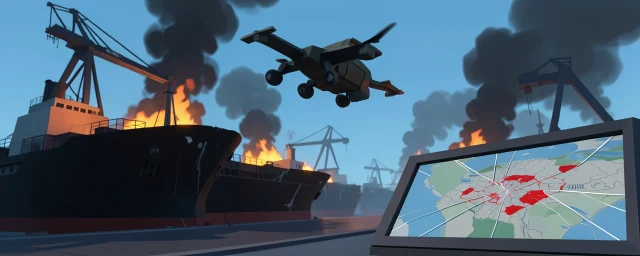
The confrontation between the United States and Iran is expanding across the Middle East, raising the risk of drawing American allies into a broader conflict. Egyptian authorities reported that a drone sparked a fire on two gas vessels in the port of Damietta on Wednesday, and although no group has claimed responsibility, the incident has deepened concerns about a widening war.
Why it matters for the market
The attack on Damietta highlights the vulnerability of the Suez Canal, a critical artery connecting the Red Sea to the Mediterranean. Any disruption to that route could have significant consequences for global trade. The incident follows U.S. retaliatory strikes against Iran after a missile attack on a U.S. base in Jordan, as well as joint U.S.-Saudi strikes on Iranian-backed militias in Iraq in response to a drone assault on a Saudi Aramco facility.
Iran has blamed Israel for the tanker strike and praised Egypt as an "important friend and partner," while Iranian Foreign Minister Abass Araghchi warned against "Israeli plots and false-flag operations." Military experts, however, are skeptical that Tehran can sustain such attacks at scale. Retired Army Lt. Gen. Sean MacFarland compared the drone strike to Iran's earlier missile launch at Diego Garcia, noting that even a failed attack can shift strategic assumptions.
The escalation comes as the U.S. military prepared for a potential large-scale campaign. Washington has deployed special operations forces, additional fighter jets, and medical personnel to the region, while the State Department issued travel warnings. Late Wednesday, U.S. forces struck dozens of Iranian Revolutionary Guard Corps military targets in a two-hour barrage, a response to five ballistic missiles fired at a U.S. base in Jordan, all of which were intercepted. At the same time, President Trump vowed to respond forcefully to Iran, and a recent AP-NORC poll found 64 percent of Americans believe the conflict is "not worth fighting."
In a diplomatic countermove, Saudi Arabia hosted representatives from 43 countries to discuss forming a multinational maritime defense alliance, with 14 nations signing on. The tit-for-tat strikes this week ended a brief pause in hostilities, following 13 consecutive days of U.S. airstrikes and Iranian missile and drone responses targeting Kuwait, Bahrain, and Qatar.
What traders should watch
Analysts see Iran's actions as an attempt to divide the U.S. from its regional partners and signal that it will not accept unfavorable terms in negotiations. However, MacFarland argued that the strategy may be backfiring, as countries like the UAE and Saudi Arabia have moved closer to Washington. The situation remains fluid, with Israel, so far on the sidelines, vowing to retaliate if directly attacked.
 0
0 0
0 0
0 0
0